
The Lightning Strike Fires of 2026
On the evening of July 7th I (Amanda) was nestled in a tent with my four year old at Camp du Nord in Ely, on the edge of the BWCA. Camp counselors walked to our site to let us know some weather was on the way and to let us know where we could seek shelter.
Both our kids were zonked out after a long day at camp, so Drew and I decided to stay in our tent. We had rain gear ready if we thought we needed to take shelter. We laid there as we heard thunder that shook the earth for 10 seconds at a time. The storm felt short. The rain came in a sudden burst and left just as quickly. We didn’t think twice about it.
That storm combined with an historic heat wave, extremely dry conditions, and millions of dead trees thanks to the spruce bud worm. While the lightning ignited the fires, we finished out a glorious week at Camp du Nord. Bryana was scheduled to arrive at du Nord and camp in the exact same spot we were vacating on July 12th. The only concern on our horizon was the intense heat wave of 100+ days. I left Bryana two rechargeable fans in the bear box.
Both Bryana and I assumed she would be able to spend a full week at camp. I had a BWCA permit for Thursday through Sunday, July 16-19th.
On July 12th, Bryana arrived at du Nord and set up an entire campsite for her children on her own in a heat that felt like 110º (superstar). At the Camp du Nord welcome session, all families were briefed on the wildfires 8-miles north of camp and current communication with the U.S. Forest Service. As the welcome session went on, families watched helicopters fly across Burntside Lake in the distance, carrying water north of us to the Boundary Waters for fire suppression efforts.
On Monday morning, July 13, the U.S. Forest service closed the BWCA for Tuesday through Friday. Eight forest rangers set off with four canoes to cover a million acres of wilderness to alert campers to evacuate.
To be honest, I felt they were closing the BWCA out of an abundance of caution. I thought the BWCA would be open by the weekend. Bryana expected she would finish out the week at camp.
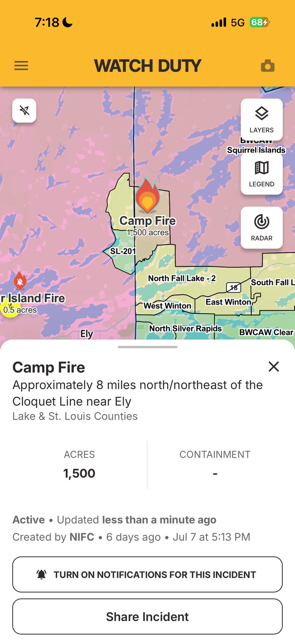
On Tuesday morning I sent Bryana a screenshot of the active fires on the Watch Duty app. The Camp Fire near Ely was 1,500 acres, the Bear Trap fire was 3,000 acres, and the Thumb fire was about 700 acres.
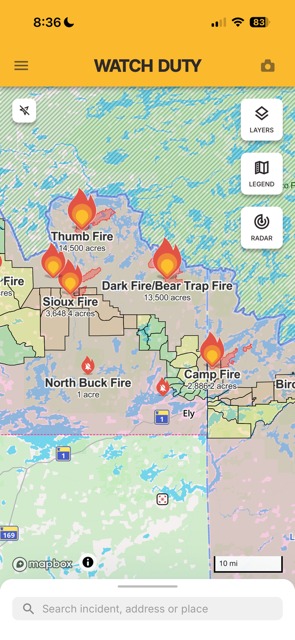
Tuesday was very windy. Tuesday afternoon I sent Bryana an update. By then, the Thumb Fire was 14,500 acres, the Bear Trap fire was 13,500 acres, the Sioux Fire appeared and was 3,600 acres, and the Camp fire was 3,000 acres.
At this point I thought Bryana should go home but she wanted to tough it out. She assured me that Camp du Nord was very communicative and on top of the safety and evacuation plans laid out by the U.S. Forest Service in the “ready, set, go” protocol. The wind direction was favorable.
Tuesday evening I taught yoga at McQuade. I could feel the strength of the wind. I saw a huge cloud bank coming in that I would later realize was the smoke.
Wednesday morning we woke up to thick smoke. You couldn’t see very far, everything stunk of fire, and the air burned your eyes and throat.
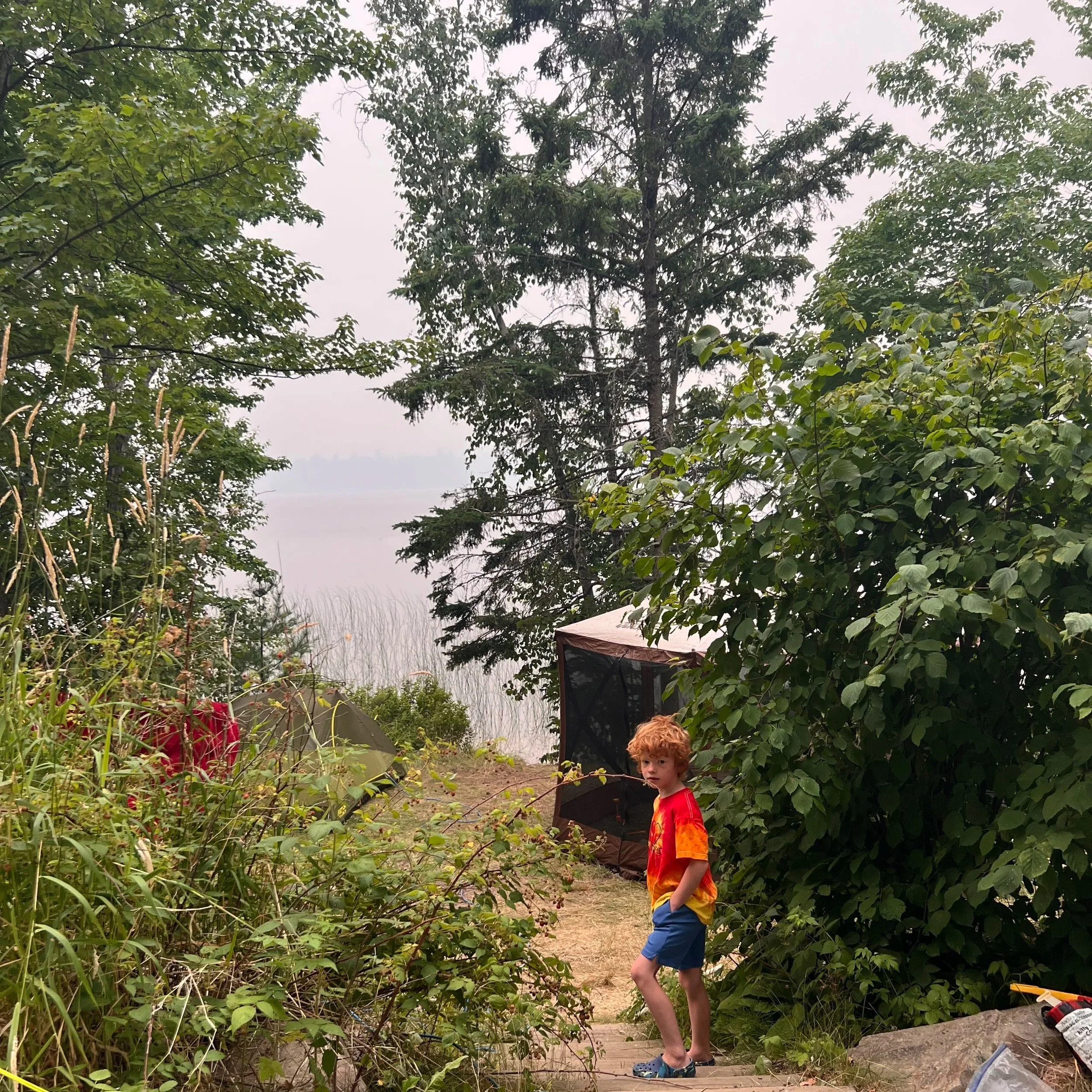
Bryana awoke to a layer of ash on everything at camp. You could barely see across the lake, and there was a thin layer of ash on Burntside Lake. The air was thick with smoke and haze. Camp du Nord announced they were evacuating the camp at 9:30 am, although this was a step ahead of the official evacuation protocol. Camp du Nord was in “ready” status, yet taking no chances with safety as well as hazardous air quality. They handled all communication and plans with the utmost of care.
On Wednesday, the Little Knife Fire spread from the Canadian wildfires into the U.S. side, miles from our friend Ashley’s beloved Birchwood Wilderness Camp at the end of the Gunflint Trail. A place that holds a special place in so many of our retreaters hearts.
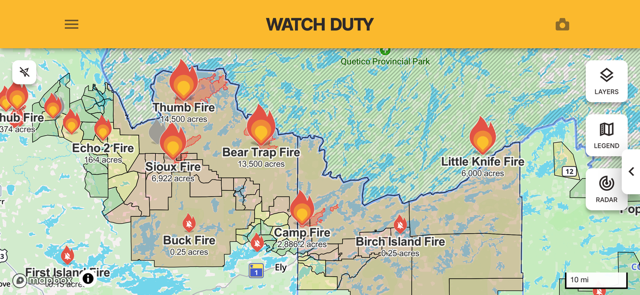
By Wednesday evening, we were hearing stories from our friends who bring campers into the BWCA of their evacuations, some terrifying.
On Wednesday, the air quality hit 876. The EPA sent people out to check the filter as it had never been that high, and anything over 500 is hazardous.
Wednesday is the day we realized this was a serious and growing situation.
On Thursday, the AQI reached even higher numbers, reaching 1,100 in Duluth.
Since Thursday, Bryana has watched every live webinar update available from Friends of the BWCA to multiple livestream town hall meetings held by the U.S. Forest Service. Also maintaining daily contact with our friends at Birchwood Wilderness Camp. Watching daily instagram video updates from Voyageur Canoe Outfitters - directly across the river from Birchwood has also been immensely helpful. Thank you Cassidy and Matt!
Every day we are desperately hoping for more clarity on how these wildfires will unfold. We are gaining more insight and information every hour. We are at the mercy of climate change and the weather. According to the experts in the field right now, the weather is providing us with unfavorably dry long-term conditions. In the short-term, the fires appear to be slowed due to recent rain and significantly cooler weather. The Little Knife fire is not currently burning above the surface, but it is still burning deep underground. This is allowing the National Incident Management Team (NIMO) time to develop a solid blueprint for the future. The reported air quality index (AQI) on the Gunflint Trail is surprisingly in the “good” zone for the past few days, and currently at a rating of only 7 as I am writing this. We will keep current with changing conditions and updates from the experts.
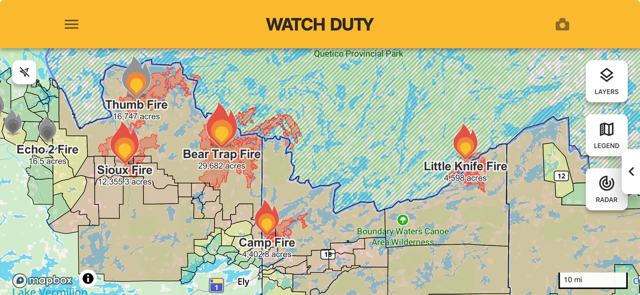
Over the past several days the information available on each fire has dramatically improved. Crews have built direct handlines and indirect dozer lines along permiters of many of the fires.
Both Birchwood Wilderness Camp at the end of the Gunflint Trail (our annual August retreat venue) and Camp du Nord outside of Ely, MN (our annual January retreat venue) remain in “set” status on the “ready, set, go” evacuations protocol. When in “set”, you should pack your emergency kit, monitor official news, and be ready to leave at a moment's notice.category).
Expert meteorologists and the incident management teams have declared that the fires will be ongoing through the fall and likely not completely end until it snows. One meteorologist said: “weather is what started these fires, and weather is what will end these fires. In the meantime we will just be managing them.” That’s a loud and clear statement, but at the same time, we can’t wrap our heads around what that will realistically mean in terms of access to the Boundary Waters, canoe country businesses, air quality, and more.
Recently the field experts have said that in order to maintain quiet within the fires, an inch of rain a week is needed. That won’t put the fire out, but would allow the fire to stay quieter. The Little Knife fire has had more than an inch of rain on it this week. As we speak, the National Incident Management team is developing a plan for the next 30, 45, 60 days and beyond. For the first time in a town hall meeting they’ve said that the Little Knife Fire is relatively calm, and they expect it to remain so this week, allowing them time to really develop an excellent strategy.
Not only are there local fire experts in these town hall meeting updates, but also locals and small business owners. Public safety is of utmost importance. At the same time, this is an awfully difficult time for folks to have their business slow, and in many instances completely halt. Right now, is the time for canoe country small businesses, summer camps, etc. to earn their revenue to sustain their operations through the winter, the year, and beyond. As one owner said, her revenue has all but halted yet expenses remain the same. The outlook with this reality is brutally grim.
Businesses surrounding canoe country, i.e. up the Gunflint, in Tofte, and in Ely are essentially desperate for your business. They are urging folks to please buy local: from online orders, to in-person shopping, to gift cards, to keeping your reservation when it’s safe to do so and making the most of it. Some folks who have had no choice but to cancel their reservations have not only left their deposit with the small business, but contributed more on top of the deposit. Where would we be without the charming, thoughtful, historically-rich small businesses of these areas?
In the town hall meetings, incident management teams have expressed that they do not need more support for firefighters at this time. One official stated, “signs of encouragement are nice and we really do appreciate those.” But he stressed that they are able to take care of their firefighters in terms of food, accommodations, etc. He urged the community to help their neighbors, check-in with them, and support one another.
So here we are, full circle, trying our darndest to support our community. First up, Birchwood Wilderness Camp is our community. Every August, we joyfully bring two sold-out sessions of women to the camp in order to embrace the wilderness, engage in mindfulness, practice canoe country skill building, laugh like children, and lean into community connection. This is a highlight of what we do at Boreal Bliss Yoga Retreats. Every. Single. Year.
Right now we are prioritizing fact-based decision-making, proactive contingency plans, and lessening risk vs. reward as much as possible. We are also a stubborn bunch. No matter what, we plan to bring the magic of Birchwood Wilderness Camp and Boreal Bliss Yoga Retreats together. We know how to have a good time, particularly in the spirit of tradition, mindfulness, and adventure; even if it looks different this year.
To speak to the kindness and care shared amongst the Birchwood Wilderness Camp community, without the owners of the camp knowing, Birchwood summer staff started a gofundme to help with the costs of evacuation, staff, and caring for Birchwood. Here is a link to Birchwood Wilderness Camp gofundme.
Thankfully, Birchwood Wilderness Camp will be running their final two-week session of summer camp for boys at Camp Foley in Pine River, MN. The care of camp communities is strong. Witnessing this team effort of two camps coming together has been heartening.
Thank you so much to the firefighters, U.S. Forest Service, St. Louis and Cass County Sheriff’s Departments, Minnesota Incident Command System, DNR, National Incident Management Operation, and all of the many volunteers.
While we hope we can retreat at Birchwood together in August, we have created proactive alternatives. We have shared our contingency plans with our Adventure Awaits retreaters. We want to be proactive: follow fact-based information and recommendations from the experts in the field, weigh risk vs. reward, make timely decisions for all involved parties (participants, venues, staff, meal planning), and provide our retreaters with an excellent experience.
Sincerely, Amanda & Bryana